

In industrial environments, research labs, and production floors, discovery isn’t always about seeing smaller—it’s about seeing clearly, accurately, and efficiently. High-resolution optical microscopy remains one of the most practical tools for understanding materials, validating processes, and ensuring product quality across manufacturing and applied research.
Unitron’s microscopy solutions are designed with this reality in mind. From stereo microscopes used daily on assembly lines to metallurgical microscopes supporting materials analysis, Unitron systems help technicians, engineers, and researchers visualize critical details that directly affect performance, reliability, and yield.
Seeing What Matters—From Microns to Measurable Results
Modern optical microscopes provide resolution approaching 200 nanometers, revealing surface features, microstructures, defects, and interfaces that are invisible to the naked eye. In industrial applications, this level of detail is often exactly what’s required—without the complexity, cost, or sample preparation associated with more specialized imaging techniques.
Unitron’s high-resolution optical microscopes support a wide range of inspection, quality control, and research tasks, delivering consistent, repeatable results in environments where accuracy and uptime matter.
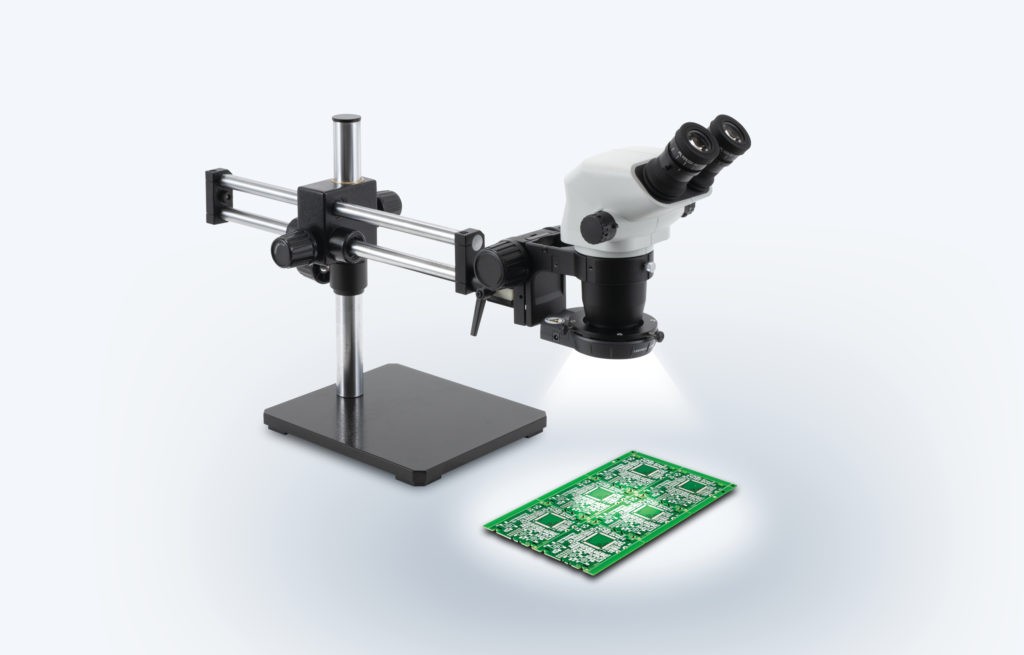
Stereo Microscopes: 3D Visualization for Inspection, Assembly, and Rework
Stereo microscopes are among the most widely used tools in industrial microscopy—and for good reason. By providing a true three-dimensional view of the sample, stereo microscopes allow users to work comfortably and precisely while maintaining excellent depth perception.
This 3D perspective is especially valuable in applications that require hand–eye coordination, including:
- Electronics inspection and rework
- PCB assembly and solder joint evaluation
- Precision mechanical assembly
- Failure analysis and component verification
In electronics manufacturing, for example, stereo microscopes enable technicians to inspect fine-pitch components, identify solder defects, and perform rework with confidence. The combination of magnification, working distance, and depth of field makes stereo microscopes ideal for tasks where users must interact directly with the sample—not just observe it.
As Unitron’s top-selling product category, stereo microscopes play a critical role in production environments where speed, ergonomics, and reliability are essential.
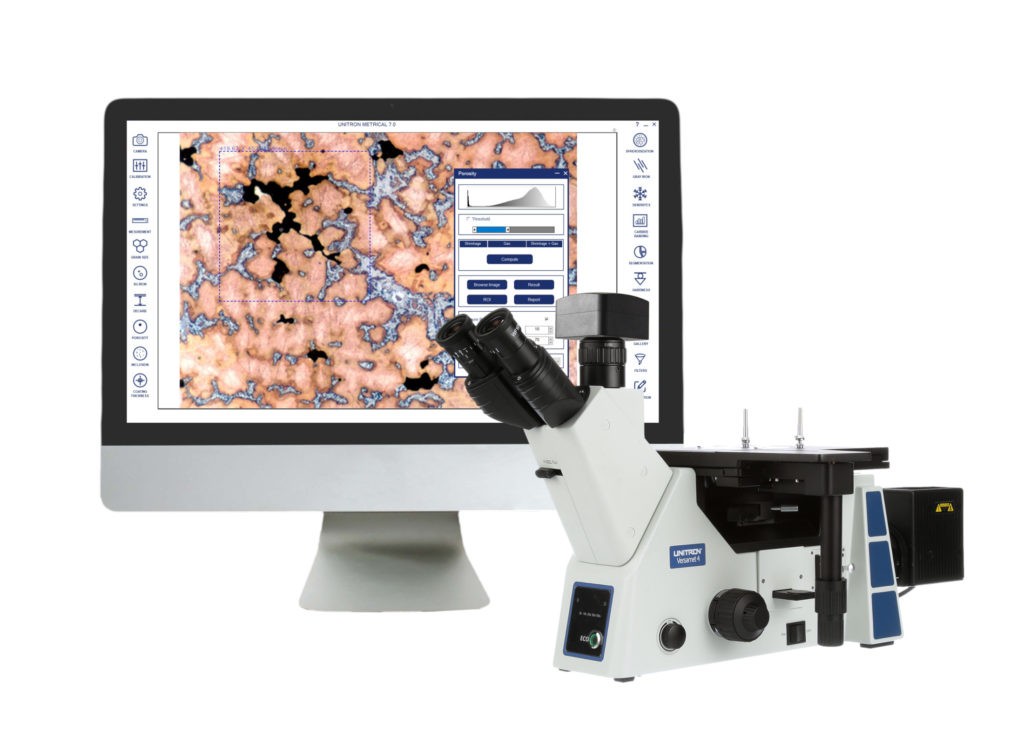
Understanding Material Behavior Through Optical Microscopy
In materials science and metallurgy, microstructure influences nearly every aspect of material performance. Optical microscopy provides a practical and effective way to evaluate these structures during development, processing, and failure analysis.
High-resolution metallurgical microscopes are commonly used to:
- Examine etched metal samples for grain size and phase distribution
- Identify cracks, inclusions, porosity, and surface defects
- Verify heat treatment processes and material consistency
Unitron’s metallurgical and materials science microscopes support routine analysis of metals, alloys, ceramics, and engineered materials, helping users connect microstructural features to real-world performance.
Supporting Material Development and Process Optimization
Throughout the material lifecycle—from R&D to production—optical microscopy enables fast, actionable insight.
Examples include:
- Metals and Alloys: Evaluating microstructural changes caused by machining, forging, casting, or heat treatment
- Coatings and Surface Treatments: Measuring coating thickness, uniformity, adhesion, and wear patterns using reflected-light microscopy
These observations help engineers refine processes, improve consistency, and reduce scrap or rework. Because optical microscopy is fast and repeatable, it remains a cornerstone of quality assurance and continuous improvement programs.
Evaluating Composite and Engineered Materials
Composite materials depend on precise interactions between fibers, matrices, and layers. Optical microscopy allows users to assess:
- Fiber distribution and alignment
- Matrix integrity and voids
- Layer interfaces and early signs of delamination
High-resolution imaging supports both incoming material inspection and ongoing process validation, helping manufacturers optimize strength, durability, and long-term performance.
Digital Imaging and Measurement for Modern Workflows
Pairing optical microscopes with digital cameras and analysis software enhances both documentation and decision-making. Unitron’s digital imaging solutions enable users to:
- Capture high-quality images for reports and audits
- Perform calibrated measurements and annotations
- Compare samples over time or across production runs
These capabilities are especially valuable in industrial and research environments where traceability, repeatability, and clear communication are essential.
A Practical Foundation for Industrial Microscopy
High-resolution optical microscopy continues to be a foundational tool in industrial inspection, materials science, and applied research. Its strength lies in delivering meaningful information quickly and efficiently—whether through the 3D visualization of a stereo microscope or the detailed surface analysis of a metallurgical system.
Unitron’s commitment to optical microscopy ensures that users have access to durable, precise, and easy-to-use solutions that support real-world workflows. From electronics manufacturing and quality control to materials research and education, these tools help users see clearly, work confidently, and make informed decisions.
Move Forward with Confidence
If your work depends on accurate visualization, precise manipulation, or reliable inspection, high-resolution optical microscopy remains an essential investment. Explore Unitron’s stereo, metallurgical, and digital microscopy solutions to support inspection, assembly, quality assurance, and materials research with clarity and confidence.